Kill Your Darlings

To paraphrase an old writers’ adage, “Give ’em what they need, not what they want.” It’s the writers’ version of “Eat your vegetables,” except the results should be far more delicious than nutritious. I was reminded of this multiple times this week, which saw the deaths of four major TV characters, with varying results. In all but one instance, these characters were either women and/or from a minority that often has trouble getting authentic representation on television. And, frankly, it has to stop.

***The following post contains MAJOR, MAJOR SPOILERS for the most recent episodes of The Good Wife, Teen Wolf, Hannibal, Scandal, Person of Interest. Seriously, if you haven’t seen those shows and want to, DO NOT READ THE REST OF THIS. ***

Until last night, this post was going to bemoan the constant and incessant killing of female characters in shows populated mostly by men. And we’ll definitely get to that! But then The Good Wife aired one of the most audacious episodes of television in my long history of viewing, one which completely exploded its narrative and leaves us with a show where three of the four major leads are women. So, it can be done, and done well. But let’s go back to the writers who get it so wrong.

I’m not someone who thinks character deaths should never happen, but I also don’t think they need to happen. Action and supernatural shows will obviously have a higher body count than workplace dramas. The Sopranos will always put down more characters than Mad Men. Shows like Game of Thrones and 24 have made cottage industries out of the question, “Who will die?” But none of these shows have treated death like a game. Each and every character lost had resonance, both to viewers and within the narrative. It was, quite simply, the story that needed to be told.

When Person of Interest killed the only black female character on its whitewash of a show, was that a story that needed to be told? When Scandal – a show, it should be said, redolent with women and people of color – killed its one openly gay character, was that a story that needed to be told? How about Hannibal, on which the brilliant Asian female doctor makes a typical ‘dumb girl in a horror movie’ decision and ends up (possible) cannibal fodder, whereas her two white male lab tech colleagues are allowed to be brilliant without being stupid. They really couldn’t have gotten rid of that guy who isn’t Scott Thompson? (I would never be so gross as to suggest they off a former Kid in the Hall.) Oh, and let’s not forget that Lawrence Fishburne is likely a goner by season’s end.

But these decisions, the writers of these shows argue, aren’t arbitrary. You can’t kill characters the audience doesn’t care about. Right. Because the audience doesn’t care about the white male characters on these shows at all. And these white male characters that no one in the audience cares about aren’t being kept on the show for reasons like, oh, the primarily female audience is more interested in having them around to stoke their fantasies and ship their romantic entanglements. If even one white male character is killed, they might actually lose viewers. It might re-write the very nature of the show. Or, you know, they might have to write storylines in which these women and minority characters are independent from their male counterparts, have agency, and drive the action. Now that really would be a scandal.

Exhibit A (and isn’t it always): Teen Wolf. This was Allison’s final season, though you would have never known it, since she was made completely redundant after years of waffling between Buffy-manqué and back-burner love interest. Her final episode was the most ham-fisted, last-minute fix-up I’ve ever seen, giving her the lamest post-coital banter in the history of television and a heart-to-heart with her dad that so obviously telegraphed her death, the special effects team might as well have painted a bull’s-eye on her forehead in post. I felt exactly zero ounces of sadness at her death because I had guessed at the beginning of the season that it was going to be her. From a writing standpoint, the choice makes sense: she was a cypher on the show where she was the female lead. They brought in a character so glaringly positioned to replace her that they actually had them team up in the episode prior to her death. But this was a failure in the writers’ room.

It’s not like Allison never had potential. She has a family with a long and twisted history. Her mother died during her formative teenage years. Her boyfriend was a goddamned werewolf, for Pete’s sake! But in the end, like in every episode of the show, she lived and died for Scott. God forbid she become a better hunter, tracker, fighter than the male lead. That she become better at deciphering some of the mythological lore than Stiles. That she genuinely oppose the supernatural beings on the show and maintain that stance, even while loving them as her friends, causing a downward spiral that permanently affects the character. They flirted with these ideas, but television is always about bringing your plot and your characters back to the status quo, and so Allison, at the moment of her death, even though in recent months she’s had stronger relationships with both her father and Isaac, declares her love for Scott. Kind of fitting, really, since no matter what she did, it always brought her back to him.

The big bait-and-switch of the season, of course, was the writers’ flirtation with killing Stiles. I agree with the general consensus that killing Stiles would spell the end of the show; he’s one of those characters, like Sawyer on Lost and Eric on True Blood and Roger Sterling on Mad Men, that you just can’t kill without totally losing your audience. Interesting how those invaluable characters are almost always male characters. On Teen Wolf, killing Stiles would be catastrophic, mostly because of the actor’s popularity and talent, and the fact that he’s the one character on the show written with any consistency. But what if, say, they killed Scott. Could the show go on without its titular teen wolf? Survey says… yes. Right? Because there are a host of male characters waiting to take his place. The show could become about Stiles, or Derek, or Isaac (with a lot of adjustments), or the Twins. Hell, even Papa Argent and Sheriff Stilinski. No one would need to be brought in to replace Scott. But the show is so low on female characters that they did have to replace Allison. We’ll see if Kira gets anything to do next season, her first non-kitsune season, other than be Scott’s girlfriend.

So why can’t more shows take risks like that? Why can’t more shows give us what’s good for us, narratively, rather than what we want? Why can’t shows rely on expertly written and beloved female characters to carry a show’s drama, saying something about modern women that has little to do with the men in their lives?

This is where I was going to leave you (ish), but then The Good Wife killed Will Gardner.

Who was an amazing character, having an exceptional season. It was the gut punch to end all gut-punches, and this morning, everyone is moaning and wailing about never watching the show again, as usual. I may be in the minority, but I *want* to watch dramas that shock me to the core. That challenge me, that rivet me, that make me so insane that I stay up way too late trying to come to terms with what just happened, and the next day still feel a little fuzzy and shaken. Episodes that make me put sun tan lotion on my toothbrush and almost feed my dog a can of tomato paste (true story) because I’m still sunk in. Episodes like “The Body” on Buffy, “Home” on The X-Files, “The Red Wedding” on Game of Thrones, and “Commissions and Fees” on Mad Men, to name just a few (I would add last year’s Downton Abbey Christmas special, but not even I think we should have had to deal with that crap at Christmas. Mary is better off, though!). I want to be gut-punched. I want to bleed. I also want the writers to earn it. Here, they definitely did.

The most vocal and insistent protest in the aftermath of Will’s death is that the show has jumped the shark because there will be no HEA for Will and Alicia. Never mind that Alicia had her chance for that HEA and chose to start her own firm, launching a Molotov cocktail into Will’s heart, at the beginning of this season. Never mind that they have been bitter, volatile rivals for the better part of the last 10 episodes. Never mind that the entire premise of the show is Alicia’s struggle to define and discover herself beyond the crushing legacy of her husband’s betrayal. The only way that was going to be possible, apparently, was if she found happily ever after with Will and fell back into another white picket fence scenario – or maybe here it would have been dual managing partnerships at their very own firm.

Newsflash: Alicia exists beyond her relationship with Will. Or with Peter. Or with Cary. Or with anyone, really. The central question for the character and of the entire show was asked of Alicia by another high-powered female character last week: “What do you want?” Who does Alicia want to be? How will she become that person? How does she deal with the obstacles put in her way – the assumptions about her character, the restrictions on her based on those assumptions? That is what has kept me enthralled with The Good Wife all these years, and the thought of her and Diane and Kalinda carrying the show through the rest of the season and beyond thrills me to the core. Finally, a team of writers willing to see beyond the shipping and the traditional ‘will they, won’t they’ romance storyline. Finally, a show willing to sacrifice a male lead to see what the strong, complex, vital female characters will do in the future.

Goodbye, Will Gardner. I loved you. So did Alicia. But she’s so much more interesting now that you’re gone.

Television would be so much more interesting, and diverse, and rich, and messy, and complicated, and must-see, if more writers were willing to feed us our vegetables and kill our darlings.  

Real Heroes

Some recent family events  (basically, mule-headed 92-year-old Italian man plus decades of family dysfunction vs. granddaughters) have prompted me lately to muse on the real nature of heroism. It’s a word, in my opinion, that gets overused, or that perhaps needs a redefinition. While I certainly wouldn’t argue against using the word ‘hero’ when referring to a firefighter, or a police officer, or a veteran, I don’t think heroism should be relegated to the emergency and rescue sphere. There is heroism in the day to day dirge of providing someone with care.

Call it a moment of clarity, a minor epiphany, or a total lack of sleep, but sitting in a hospital hallway the other day, I couldn’t help but marvel at the incredible people whose job it is to scrape the fungus from between an overweight person’s stomach folds (yes, fungus) and still keep a smile on their face. To deal with a never-ending array of runny bowel movements, sick-up, bloodletting, and even gnarlier conditions. Who can brighten the day of someone in massive kidney failure, while patiently explaining to them their treatment options. The orderlies and nurses and aides who do not get the doctor glamor, who get screamed at by patients and family members and random strangers, who get blamed for everything and thanked for nothing, who have to perform some of the grossest tasks imaginable and get a bacterial infection for their trouble. The kind of people who take time out of their endless shift to sit with a mentally ill patient in a room of four who talks non-stop. The kind of people who inspire patients in long-term rehabilitation facilities to put their lives back together step by step, day by day. The kind of people who sit with our oldest, our loneliest, our unloved, our abandoned through the last moments of their lives.

The kind who put up with an ornery, cranky, and downright hostile 92-year-old Italian man and his demanding granddaughters.

To those and all the other real heroes of the world, thank you.       

Buffy’s Daughters

Lately, I’ve been binge-watching the latest season of Teen Wolf (having sworn never to watch it again after the steaming turd that was Season 3A, but what can I say? The Olympics are giving my DVR an enema, cleaning out all the old shit I haven’t watched), which is going through its very own Dark Willow storyline in the form of trickster!Stiles. That, and the latest cover story in Entertainment Weekly, on the Veronica Mars movie, got me thinking about how many shows owe their existence and a huge debt to Buffy the Vampire Slayer, the blueprint for supernatural and occult-influenced fantasy horror shows. If you’ll indulge me in a little pop culture riffing, I’ll share.

***Please note that the following contains mild spoilers for a host of television series, notably the most recent season of Teen Wolf. If you haven’t seen them and want to, tread carefully.***

While not the first television show to explore things that go bump in the night, Buffy weaves together the strengths of its predecessors without outright copying any of their elements, spinning these disparate strands into a strong, original yarn. Even The X-Files owes more to Kolchak the Night Stalker and the Twilight Zone than Buffy does to… well, to no television show I can think of. Buffy is a unique mix of  action, horror, mythology, pathos, and humor, subverting archetypes and promoting girl power while resonant with emotion. Buffy, the cheerleader-turned-chosen one, is the nominal star, but she’s supported by a true ensemble. Unlike most eponymous characters, she’s not the loss-leader in that she’s just as interesting as everyone else. These qualities, along with the season-long big bad structure and the light flirtation with camp, would go on to be mirrored in every supernatural show that followed.

And some where the only demons are of the metaphoric variety. That EW article reminded me that Veronica Mars was, like Buffy before her, a mean girl forced to go good because she no longer fit in with the Plastics of the world. Like in Buffy, Veronica’s best cases of the week illuminate something about the emotional struggles of one of the characters, most often Veronica herself. But Veronica does Buffy one better in that she is much more capable, competent, and confident in her abilities where solving mysteries is concerned. Her love life is just as much of a train wreck, and the consequences of some of her bad decisions – like the show itself – are a bit more real, if no less visceral. Joss Whedon was an avowed fan of Veronica Mars, which is no surprise, because it’s basically a love letter to him.

It’s one thing, though, to be inspired by Buffy and create a whole new world as a consequence; it’s another to copy the format and approach wholesale, making only superficial changes. Like the gender of the lead character(s). Yes, kids, it’s time to play Buffy But With Boys, AKA Smallville, Supernatural, and Teen Wolf.

I can’t say I was ever an avid watcher of the first two, but I was persuaded (some might say peer-pressured) by my two long-time friends N. and A. to give Teen Wolf a try. Of course, they dangled the promise of slash in front of my nose like the proverbial carrot – how could I be expected to resist? Unfortunately, the slashy couple in question, nicknamed Sterek, wasn’t of particular interest to me, but I found myself entertained by the show all the same. It’s a fascinating case study, since the show gets at least as many things wrong as right in any given episode, but is still fun and watchable.

If anything, the writers might want to learn a few more things from Buffy, such as writing genuinely strong female characters with agency. They also have this frustrating tendency to manipulate their characters to fit the plots they have outlined, as opposed to letting the plots be inspired by their character’s inner struggles and shortcomings. The current Dark Willow ‘homage’ storyline is the perfect example. In Buffy, Willow went over to the dark side for a host of deeply emotional reasons: her irritation at not being allowed to explore her powers to the fullest, her resentment towards Buffy, her fear of how much magical potential was inside of her, and, most heartbreaking of all, the murder of her lover, Tara. On Teen Wolf, Stiles is possessed by a nihilistic trickster fox spirit, but I can’t think of one concrete emotional reason why this would happen to his character, other than to give the cast’s strongest actor, Dylan O’Brien, a chance to shine. Which he does. The storyline is fun, and thrilling, and engrossing by turns, but it’s all glossy artifice. On Buffy, the Dark Willow storyline hurt viewers where we lived.

To my mind, the true successor to Buffy’s throne is… wait for it… Fringe. Yes, it started off as an X-Files rip-off. I actually remember saying to someone that I’d stopped watching the first season after a few episodes because “I’ve seen The X-Files.” But then, at the end of that first season, something curious happened. Fringe learned how to go deep. It began to mine and mine and mine its characters, all the while bedazzling us with some diamond-quality mythology and sci-fi gems. Olivia Dunham out-Buffy’d Buffy in terms of emotional isolation and willingness to sacrifice herself to the cause. Her doomed romance with John Scott was like a mini-Angel situation, with Peter later cast as a gloomier, but no less sarcastic meld of Spike/Xander. With her very own Scooby Gang around her, each member so unique that that’s really where the direct comparison with the characters on Buffy ends, Olivia, like her mother slayer before her, came to understand that she was, in her own way, a chosen one. Then Fringe took some basic Whedon tropes psychedelic, and blew everyone’s mind, with its alternate universes, dopplegangers, and Observers.

While too derivative to be a blueprint in its own right, Fringe went where no sci-fi action show had gone before, while never losing its emotional core. Just saying certain characters’ names makes my heart sigh: Lincoln Lee, Astrid, September, Walter. Oh, Walter! I can cite Fringe episodes that moved me to tears the same way that I know the names of the Buffy episodes that cut deep: “White Tulip” and “The Bullet That Saved The World” in the former, “The Body” and “The Gift” from the latter. In spirit and execution, Fringe is Buffy’s spiritual daughter.

There are countless other shows whose creators undoubtedly double-dipped in the Buffy, er, dip – True Blood, The Vampire Diaries, and Sleepy Hollow come to mind, and to a lesser degree Arrow. I keep hoping that one day an innovative showrunner will get the chance to bring his or her (preferably her) original spin on the action-horror genre to life, that someone will sketch a new blueprint for lesser shows to follow. Until then, I’m just grateful to have gotten in on the ground floor of Castle Whedonverse, when only the chosen few knew how special and how revolutionary their little show about a girl who slays vamps and saves the world a lot was.           

Review: Coriolanus

Theatre is in my blood. I love reading it, writing it, performing it, directing it. Whenever someone would ask me, “How would you like to die?” my answer was always, “Performing on stage in some septuagenarian production of an Agatha Christie play.” I used to live in London, England, and would haunt the West End every weekend, squeezing my behind into as many of their tiny, tiny seats as I could afford to during my time there. I don’t think it’s an understatement to say I saw over 100 plays, from dramas to musicals, Shakespeare to the modern masters, hole-in-the-wall productions to main events on Shaftsbury Avenue. Being so close to such culture is the one thing I miss the most (not to say that Montreal doesn’t have its share of culture).

When the National Theatre began to broadcast some of its plays in cinemas around the world, I discovered a new temple at which to worship. Theater should, after all, be for the people, and the fact that so many can now see the best actors, directors, writers, and stagecraft wizards of all time by taking the bus to their local and shilling a mere $20, well… Just another boon of the digital age. So far, I have seen both versions of the Danny Boyle production of Frankenstein starring our two contemporary TV Sherlock Holmeses (they alternated parts – the best was JLM as the monster and Benedict as Victor Frankenstein), Helen Mirren reprise the Queen in The Audience, Kenneth Branagh play Macbeth, the 50th Anniversary of the National Theatre celebration special, and, last night, Coriolanus starring Tom Hiddleston.

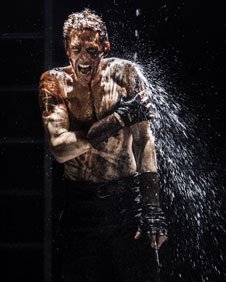
Tom Hiddleston, foreground, as Coriolanus, at the Donmar, London, December 2013.

A Donmar Warehouse production directed by Josie Rourke, Coriolanus is the story of an early Roman general who excels at being a war hero, but who self-destructs when his ambitions, arrogance, and snobbery lead him into politics. Raised by a domineering mother to be the ultimate one-percenter, he is a brave and loyal man with good intentions who can’t see past his own prejudices at a time when Rome isn’t the epicenter of the ancient world, but a county full of warring tribes.

This staging has allegedly done away with a lot of the pomp and circumstance of past productions, paring both the set and the text down to their bare essentials. This is the kind of minimalist theater that entrenches itself deep in the heart, rich with symbolism, centering on performance, leaving space for the audience’s imagination. With a bunch of black chairs, a few ladders, some paint, some graffiti, and a bucketful of fake blood, Ms. Rourke, her crew, and her actors conjure up a tragedy as if by Satanic ritual. As someone who had never seen the play before, I had no trouble at all understanding what was going on; this is what I love about modern British theatre. The actor’s speeches were lucid, not flowery, imbuing the poetic lines with meaning and power.

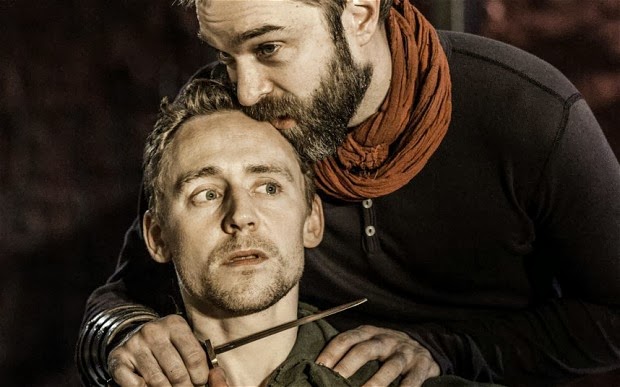
As Coriolanus, Tom Hiddleston owned the stage. He is young to play the role – it’s usually reserved for someone middle aged – but he’s so good that you can’t help but think that this is what Shakespeare must have meant the character to be all along. He gives the character so many shades – earnestness even in his naivety, principled-ness even at his most arrogant, paternal love even as takes a hard stance against his family – that the reasons he succumbs to his tragic flaw are, while inevitable, totally understandable. He handles the nuances of Shakespearean language as if it was his mother tongue, and gives his body entirely to the production: the fight scenes, the close-ups, the camaraderie, everything. Everyone else in the cast, right down to the ensemble players, is brilliant: Deborah Findlay as Volumnia, Hadley Fraser as Aufidius, Birgitte Hjort Sorensen as Virgilia. Triple-threat Sherlock producer and Whovian Mark Gatiss is especially suave and heartbreaking as Menenius, the perfect conniver until the tables are turned on him. The only sour note in the cast was struck by two actors who played Brutus and Sicinius, who were serviceable but who never really gelled as a pair (especially since they were supposed to be lover-schemers) or as a credible threat to Coriolanus.

There’s even a little homoerotic subtext made text for your viewing pleasure!

_71817911_hiddleston2_body

Overall, a riveting production. There is an encore screening later in the month of February, and if you are lucky enough to live close to a cinema playing it, I wouldn’t miss it! All sorts of info about this and upcoming screenings can be found here: http://ntlive.nationaltheatre.org.uk/ I would particularly recommend the encore presentation of The Curious Incident of the Dog in the Night-Time, since I saw that live in London last spring and it is easily one of the best plays I’ve ever seen. Whatever they are doing at the National Theatre, they are definitely doing it right!

coriolanus_2768141b

Miss Kray’s Editing Tips #2 – Trimming the Fat

Last fall, I took a course on literary stylistics, and it was a real eye-opener in terms of grammar, syntax, and style. It was headed by Jeffrey Moore, author of The Memory Artists (I have a policy never to read an author’s books before I take a seminar with them, but he won the Commonwealth Prize and I have it on good authority that he’s a fantastic author). I have been trying to segue from being a copy editor into more substantive editing, and this course definitely delivered on both the writing and editing fronts. I won’t give away all the secrets I learned there, but here are a few I’m applying to my first book, which I’m giving another polish before submitting it to the next publisher on my list.

1. Read your work aloud. Punctuation equals breath sounds: a comma, a dash, or a colon is a half-stop; a semi-colon or a period is a full stop. Listen to where you stop, pause, inhale – it shouldn’t be in the middle of a sentence clause. If something sounds awkward or is hard to say, revise. If a sentence runs on too long and there’s no place to take a breath, revise. If you end up twisting your tongue around some witty bit of alliteration, revise. If you can’t read it smoothly… you know the drill.

2. Let the noun or the verb shine. Let them have the impact they deserve. With adjectives and adverbs, less is more. Cut out as many of the ‘-ly’s’ and long strings of descriptors as you can. Those that remain should contribute to the meaning of the sentence, not act as a literary form of whip cream. As Kristin Scott Thomas’ character in Four Weddings and a Funeral might say: “Nobody wants to look like a meringue.” That includes your sentences.

3. When writing/editing dialogue, put as few ‘Soandso said’s’ as possible. If there are only two people having the conversation, you don’t need any. If there are multiple characters, try to minimize them by beginning or ending your paragraph with a descriptive sentence. Here’s an example from my own novel, Like Stars. Beatrice is trying to console Wesley by feeding him pie.

It was some time before Beatrice felt him squeeze in return.
“Has the tea gone cold?”
“I imagine so.”
“Mmm.” Wesley pursed his lips. “Raspberry?”
“With custard.”
“No custard.” He opened his far hand to receive his plate, perched it on his lap, then accepted a fork. At no time did he move to break her hold on him. He dug into the pie with more vigor than she had expected, which led her to wonder when he had last eaten. She suspected it was breakfast. After scarfing down three forkfuls in quick succession, he broke for air. “Tart. Lovely.”
“It’s all Mrs. Rutland’s doing.” She could not help but smile.
“Nonsense.” He scraped up the last streaks of jelly and crumb. When he finally looked at her, it was with the feigned innocence of a child begging another biscuit from its mother. “Are you not…?”
“I’ve had my fill for today.” They traded plates.

Would the above dialogue be improved by putting ‘Wesley asked’ after the first comment? Or ‘Beatrice replied’ after the second? By joining the fragments ‘No custard.’ and ‘Tart. Lovely.’ to a descriptive paragraph about Wesley, it is obvious that he’s the one speaking. Ditto the dialogue that goes with ‘She could not help but smile.’ Throughout this entire, three-page exchange, there is not one ‘said’ or ‘asked’, and yet it’s clear to the reader who is speaking at all times.

If two characters are arguing, you could dispense with the descriptive sentences altogether. It depends on what kind of mood you want to create. Using short, to-the-point lines is called stichomythia, a term from Greek drama meaning: “a technique in verse drama in which single alternating lines, or half-lines, or occasionally pairs of alternating lines, are given to alternating characters” (http://en.wikipedia.org/wiki/Stichomythia). It works just as well in a novel or a short story.

The point of all this is, of course, to get rid of what Mr. Thomas Kane, author of The Oxford Guide to Writing (1983) calls ‘deadwood’, or “words that don’t contribute in any way to a writer’s purpose” (OGTW, p.272). The above are three examples of deadwood; there are many others! All help you to follow Somerset Maugham’s dictum, and my writing mantra: “Lucidity. Simplicity. Euphony.”

Or to put it another way: chop, chop, chop!

Happy editing!
-S. ;D

An Open Letter

Dear Former Child Star Who Needs Publicity For Her Book To Keep Her Family Afloat Since She Doesn’t Get Much Work Anymore And Her Husband Is Retired From The NHL,

Congratulations on being a submissive wife to your husband! I know I shouldn’t be giving you or your opinions any more publicity, which is why your name has been redacted from this post, but the kind of revisionist family values BS you are spouting lately – not that any of us have heard anything from you in a looooong time – really sticks in my craw.

It’s your right, of course, to say what you want; I would never claim otherwise. But let me exercise my freedom of speech to tell you where you can stick your ideas about the roles of men and women in a marriage/relationship. It’s one thing, you see, to do what works for you in your own marriage; it’s another thing to use this backwards and outdated idea of gender roles as publicity. Between you and that famous volleyball player who also needs to submit to her husband’s will to keep the peace in her marriage, I’ve had just about enough of your proselytizing (look it up) as if you were some kind of moral authority and not someone who is on her latest desperate attempt to revive her career by selling a lifestyle brand.

I’ll start by referring you to a blog post by Lainey Liu, who outlines the hypocrisy of your position, given that you are most likely the breadwinner in your family: http://www.laineygossip.com/Candace-Cameron-Bure-is-a-submissive-wife-in-recent-US-Weekly-article/29056.

I’ll continue by quoting a response sex columnist Dan Savage recently gave to a reader:

‘There was an article in The New York Times recently about how young men still aren’t doing their fair share of the cooking and cleaning. “Women today make up 40 percent of America’s sole or primary breadwinners for families with children under 18,” Stephen Marche wrote. “[But] men’s time investment in housework has not significantly altered in nearly 30 years.”
Reading Marche’s piece—in which he makes the case not for men to do more housework (God forbid), but for men and women to live together in filth—made me say, “So glad I’m gay.” Out loud. On an airplane. I sometimes have that reaction when I read stories about “the gender wars,” which Marche is currently writing a book about, or when I read smut-shaming bullshit about straight men and porn. But Marche’s essay elicited a different sort of so-glad-I’m-gay response. It went something like this: “I’m so glad I’m gay because my husband and I don’t have the option of defaulting to the stupid gender norms, roles, expectations, neuroses, and riptides that plague so many straight couples.”
So despite the fact that we’re both men, my husband and I do not live together in filth. When a bed needs to be made or a dish needs to be washed or a floor needs to be mopped—or a spouse’s cock needs to be sucked—one of us makes, washes, mops, or sucks it. When there’s something that needs doing, we do it. We don’t sit around staring at an unmade bed or a dirty dish or a grimy floor or an unsucked spousal cock and think, “I have a dick—so bed-making/dish-doing/floor-mopping/cock-sucking isn’t my job.”’ – Savage Love, December 18th, 2013.

Gender norms are norms because people allow those attitudes/stereotypes/ideas about whose role it is to do something to affect their lives and their decisions. But as LGBTQ couples prove, those gender roles mean absolutely nothing when there’s laundry to be done and only two guys or two girls to do it. They are just social constructs – powerful and enduring social constructs, to be sure – that will only continue to exist so long as couples perpetuate them.

Lastly, I’d like to take exception with your idea of submissiveness as weakness. I know, I know, that’s more or less the formal definition, but hear me out. I daresay the submissive partner in any BDSM relationship would argue against the idea that they are weak, or powerless, or being unfairly taken advantage of, mostly because they are fully engaged in expressing their sexuality while submitting to their more dominant partner’s attentions. Ditto aggressive bottoms. And let’s not forget psychology’s greatest contribution to the pop lexicon in the last 50 years, passive aggression, as essential to a submissive person’s arsenal as a faked orgasm.

So you can go on being “submissive” to your husband, clamp your white-knuckle grip on those gender norms, Former Child Star, but you’re not fooling anyone. While some women are genuinely stuck at home, raising their kids with little to no help from their husbands, you’re out on a publicity tour to promote the book you didn’t really write.

If there was ever a time to know your role, this is it.

Bisous,
Selina

Miss Kray’s Editing Tips (for the Grammar Geek in all of us) #1

Editors. We love ’em, right? They chide us, they prod us, they nitpick us to death, but in the end we’re grateful because the text not only looks better, it reads better. A far greater writer than me, Somerset Maugham, had one motto when it came to writing: “Lucidity, simplicity, euphony.” Words to live by, IMHO, and the mantra that I keep in mind both as a writer and an editor.

(Yes, I’m trumpeting my own profession here. What can I say? We’re a dying breed. If we don’t stand up for ourselves, who will?)  

Given the warp-speed at which language is changing in this cyber age, it’s sometimes impossible to tell what’s correct and what’s misused so often it becomes accepted. Just the sheer amount of acronyms coined every day is enough to make a thirty-year-old feel like a cave dweller. Not to mention job/social group/fandom-related slang and abbreviations, a by-product of the corporate and advertizing double-speak meant to build up those worthy and shun those hopelessly out of the loop. Any editor worth their salt can’t just be satisfied with keeping up with the Joneses, they also have to keep up with the Apples, the Googles, the hipsters, the glamazons, the Destiel obsessives, and the #Ichabbie shippers (depending on their area of expertise). Every winter, the OED comes out with its quaint little list of Words of the Year, and the media does a pity story about the addition of ‘selfie’ to the dictionary, but the truth is, by the time a word gets the OED stamp of approval, it’s already collecting a pension in cultural relevancy terms. Anyone who thinks otherwise should try subtitling a Tyler Perry film, and let me know how that goes.

Also, let’s face it, a style guide is little more than a dress code. It’s primary purpose isn’t accuracy, but efficacy. Style, by definition, is “a particular way in which something is done, created, or performed” (http://www.merriam-webster.com/dictionary/style). In theory, there’s no right or wrong; it’s just the way it’s being done by the stylish person or thing.

Before you start thinking that this is some “Down with the Oxford comma!”, anti-grammar screed, I would argue that literary style, like fashion, is important, but it should never keep you from having fun. Not everybody needs to be bedecked in haute couture, but there are a few basic essentials that cannot be done without. The rules of grammar and syntax, for instance, aren’t arbitrary. Believe me, feuds have been fought over less. The Hatfields and the McCoys have nothing on the members of the Editing Canadian English editorial board, I’m sure. We word geeks love our turf wars, and we all have our favorite battles, siege tactics, and secret weapons. So while a comma splice or misused hyphen on a blog post might make us cringe, it’s hardly a case for the literary equivalent of the Hague. (And how I wish there was a place you could be prosecuted for crimes against syntax. Just because it would be awesome!)

Anything released by a publishing house, however, should be beyond reproach. The text should be Alexander McQueen-level flawless, and so often that just isn’t the case. Romance novels, like Karl Lagerfeld, whose publishers often don’t employ professional editors and who pay a pittance for what is extremely challenging work, are some of the worst offenders. Though I am still learning the tricks of my trade and am by no means an authority on all things grammar (that’s Frances Peck, http://www.btb.termiumplus.gc.ca/tpv2guides/guides/pep/index-eng.html?lang=eng&page=../toc), I’ll periodically point out a few common mistakes that really itch my snout.

I call these Miss Kray’s Editing Tips (for the Grammar Geek in all of us). Here are two that caught my eagle eye today:

1. Hastily-avoided mishap. Barely-legal jailbait. Overly-coiffed meringue. Wrong! No hyphen when the adverb ends in ‘-ly’, peeps. Why? Because adverbs are movable or switchable. For example: a mishap avoided hastily. A blue-green wheelbarrow can’t become a wheelbarrow blued greenly.

2. Hang onto, tune into, hold onto. Nyet, comrades. Think about these logically. ‘Onto’ means ‘on top of’. Can’t hang on top of something. Well, you can, but then you wouldn’t be hanging on to it, you’d be hanging over it. Same with tune in to. You’re not inside the TV show – no matter how much you might want to be. These, friends, are some fine grammatical terms called collocations, i.e. two or more words that often go together. They even have their own dictionary! (https://elt.oup.com/catalogue/items/global/dictionaries/9780194325387?cc=global&selLanguage=en) Yes, it’s often just a question of usage, which two words go together. Brits will say, “Knock at the door,” while Americans are more likely to say, “Knock on.” But that doesn’t mean you can defy logic.

Collocations come in all shapes and sizes. Some you might recognize are ‘come with’, ‘stand at’, ‘drive by’, etc. The problem here is that the second word in these fine collocations has been combined with the ‘to’ that naturally comes after it in the sentence. Of course, you will find ‘into’ and ‘onto’ in the dictionary of collocations, but usually after verbs like ‘climb’.

If you’re an editor, collocations need to become your BFFs. I know I sleep with the dictionary under my pillow. 😉


Until the next time some syntactical faux pas gets my blood boiling, TTFN, fellow grammar geeks!


***TTFN = Ta-ta for now

Memorable Moments of 2013

I’m not superstitious by nature, but we all have our little quirks. Numbers are my thing. I don’t actually believe that they have any kind of power over what happens to me; it’s more like certain ones have meaning for me, and whenever they pop up in my life, it makes me smile. For instance, the month and date of my birthday can also be the time on a clock, and I always seem to look up at just the right instant to catch sight of that particular minute of the day. Now is it my brain noticing the time in my peripheral vision and alerting me to it, or is it just one of those unexplainable things? Who knows? All this to say that I was wary of the year 2013, for obvious superstitious reasons.

While I wouldn’t call it the best year of my life by any means (nor was it the worst), its highs and lows taught me in equal measure. Instead of doing a ‘best of’ list – which is kind of a weird thing to do for your life – I wanted to spotlight some of the good times and some of the more challenging times, mostly as a way of thanking the people who accompanied me on the most recent year of my life’s journey. Sorry, I can’t find a less self-help-y way of saying it than that.

Top Moments of 2013 (in no particular order):

-Dinner at Vanilla Black in London with A. and K. Not to mention the fabulous few days I spent showing off London to A. and staying at the sublime Ampersand Hotel, and then the restful rest of the week bunking down with my sister K. in Teddington. It was the perfect vacation: one part excitement, one part serenity, both a welcome reprieve from the real world.

-Speaking of my trip to London, seeing the multiple Olivier Award-winning Curious Incident of the Dog in the Night Time with the original cast, AKA the incredible Luke Treadaway as Christopher, was the best time I had in a theatre all year. Go, if you can! And wear a hard hat, apparently.

-Montreal had food trucks for the first time this year and, as a devout foodie, I was all over that! The two amazing First Fridays I went to at the Olympic Stadium, with S. and D. in August and D’s. in October, were two of my best nights ever. This city has its cultural and socio-political challenges, but you would never know it at this event, where English and French, young and old, hipster and geezer, singletons and families mingled over great food on two mild, starry nights.

-Dumplings and Macbeth with C. on my birthday, courtesy of her generosity and NT Live cinema events. The perfect way to celebrate.

-Hosting N. and C. on another Montreal adventure. Loved reconnecting with an old friend and making a Sherlock-loving new one.

-Adventures at the Atwater Market and baking Christmas cookies with M. and her new little L., who is a seriously cute little crumpet.

-Learned more about writing, grammar, and syntax in my eight-week Literary Stylistics class than I did during the entirety of my high school years.

-Being asked to be a godmother to I’s second son, S., touched me deeply. It was an honor to be a part of their family celebration and to be asked to be a shepherd to him throughout his life. As an atheist and as someone who does not want children, I was the unlikeliest of suspects, but the only thing important to I. was our friendship, and I can’t help but feel the same way.

-It wasn’t all champagne wishes and caviar dreams. My little pooch and I got attacked by a pit-bull in June, and that’s a moment I will definitely never forget. Nothing like glancing across the street, seeing a wild animal charging towards you, and thinking: “Crap, I only have about 10 seconds to live.” We were both shaken, but fine, thanks to the strength of her collar and the fact that the $&*#! owner managed to restrain her dog at the last second. Personal to her: that is why man invented muzzles. If you can’t train ’em, at least restrain ’em.

-In November, the writing gods gave and took with the same hand: finished the first draft of my second novel the same week the first was rejected. Like John Cena says, “#even stronger”.

-I’ll end on one of the most loathsome of phrases, a ‘teachable moment’. But it’s the one that has marked me the most. Like most people, I struggle with how to react to the ever-growing population of homeless in my city. There are a lot of backpackers that pass through Montreal; there is also a rampant drug scene. Because I don’t make a lot of money, I want to give to the people who need it most, so I focus on shelters and food banks. When I can, I’ll buy something in a nearby grocery store for someone begging outside. I’m no saint – I don’t do it often enough. I get very annoyed when I’m forced into a situation on the street. I’m someone who likes her personal space, and I’ve had some bad experiences with being approached by people who are obviously in need, but also volatile. I also wary of supporting anyone’s drug or alcohol habit.

One of the things that I struggle with most is seeing dogs on the street. As a pet owner who tries to put the safety and health of her dog above all else, it’s never a good thing, in my eyes, when an animal is made to suffer along with its human. It’s true that hundreds of thousands of dogs and cats are put down in animal shelters every year. It’s true that hundreds of thousands more are kept in puppy mills by some of the most reprehensible people in the world. But each of us can only be responsible for our own behavior, and it makes my heart ache when I see a dog shivering on the sidewalk through no fault of its own.

It came to the point that I would only see the dog, not the human attached to it. Even when you’re living a student or a bare bones existence, it’s easy to fall into certain routines if you’re basic needs are being met. If you’re comfortable. A young man reminded me, this year, of how comfortable I’d become. He approached me on the street in a fit of desperation, asking if I knew where there was a shelter he could stay at, asking me to buy him food. He had a dog, which was, if I’m honest, the only reason I stopped. They were both in rough shape. As I was talking to him, trying to figure out where the nearest shelters were on my phone, two students stopped to ask if they could buy food for his dog. They were very pleased with themselves for doing this. I saw myself in them, and it made me feel sick. Here was this guy asking for help, asking for shelter, asking for food, and all they saw was his animal. The dog was safe to help. The person less so, because people are so much more complicated, for reasons that I well understand – even agree with. But I couldn’t help but ask myself: ‘When did we stop seeing the person in need? When did it become so important to do the right thing, as opposed to a good thing?’

I don’t think there are any easy answers to these questions. So much depended on that particular night, that particular situation. But I took the lesson, to try to be better, to try to see past all the trappings and warnings and social conventions, to make sure I see the person in need standing before me, without judgment. I won’t claim I’ll always have a dollar for every empty cup or hat I pass. But when someone is at their end, when someone needs me, like that kid did, I will try to put aside my prejudices and be there.

So thanks for the memories, 2013. More importantly, thanks to all the lovely and tremendous people in my life – and, kid, I hope you and your pooch are somewhere safe tonight.

Happy Holidays!

Image


Whether you believe or not, whether you celebrate or not, I hope this time of year brings you joy, rest, and a small measure of peace. Wishing you, your family, and your furry creatures the happiest of holidays. And if you need a Doctor, you know Who to call…

Much love,
-Selina

P.S.: Guess what I’ll be watching on Boxing Day!

On home, bilingualism, and dogs

The holidays are a time for reflection. It’s a well-worn cliche, but I think that most people do indulge in a bit of introspection this time of year, especially if you live, like I do, in a place where winter weather forces you into a state of semi-hibernation. Especially if you are, like I am, home-bound by the first snowstorm of the season (curse you, weather gods!).

I live in Quebec, a province that has seen its share of tumult over the past two years. We are a French enclave in an English/Spanish continent, a source of constant social tension between the Francophone majority and the English and Allophone minorities. I won’t go into the gory details, but let’s just say the current political scene bears a striking resemblance to that of Berlin circa the 1930s. I wish I was exaggerating. So the question that’s been hanging over my head like the blade of a guillotine this year is whether I want to stay in a place where the political leaders privilege one language/culture over the rest.

Montreal has been my home my entire life, except for the one year I fulfilled all of my prim and proper anglophile fantasies by studying in England. It’s artsy. It’s historic. It’s multicultural. The countryside is near, if that’s your thing. The mountains are near, if that’s your thing. I feel safer walking its streets than in any other city I’ve ever visited – including rural southern Ontario towns. I love my neighborhood, a melange of rich and poor, hipsters and closet suburbanites, blue collar families and business folk, where everything I need is within walking distance and the downtown core is only a bus ride away. But what I love best about my neighborhood, my city, my province is the very thing that’s tearing it apart: language issues.

What I really wanted to talk about today was dogs. Don’t worry, it’s all going to come together in the end. I have a little Pemmie – aka a tri-colored Pembroke Welsh Corgi – who is the light of my life. This will not be the last time I mention her. Something I learned while she was training me (okay, so the second thing I learned after ‘dogs train you, you don’t train them’) is that dogs don’t have an agenda. They are true innocents. They have wants like any other creature – food, affection, exercise, sleep – and they are not above being sneaky to get those things, but the rest is remarkably black and white. They take the world as it comes. You have to work to make a dog aggressive; I don’t believe they start out that way. When they meet another dog, they like them or they don’t: the end.

You would think dog-walking in a city with language tensions would be problematic, but no. Somehow, when it comes to the dogs we adore, it doesn’t matter if you’re French or English – or Russian, or Portuguese, or Japanese, or Muslim, or whathaveyou. I have never once met a foreign language-speaking dog owner who was rude to me. I am bilingual, but with a slight accent when I speak French. In a city where people develop ‘language radar’, I stand out as an Anglophone. My fellow dog owners and I still do the awkward dance around ‘What language will we speak to each other?’ – a daily occurrence here in Montreal – but once we figure out the steps, our conversation finds a rhythm. Our dogs, as with any pair of pet owners, are our common ground. It’s easy to respect someone who loves what you love.

Why is it so much harder to respect someone with a difference in opinion, life experience, religious practice, upbringing? Why does something as essential and valuable as language divide us? Why can’t we embrace both English and French, cherishing the fact that bilingualism makes us stronger, smarter, richer, more cultured? Why does the best thing about this province have to bring out the worst in its people?

Thanks to humans, there are dozens of types of dogs, and most of them get along just fine. This issue, this province, its conflicts are anything but black and white, I know. But as the year comes to a close, and I once again consider leaving this city that I love, I can’t help but think that we could do worse than look for answers at the dog park.